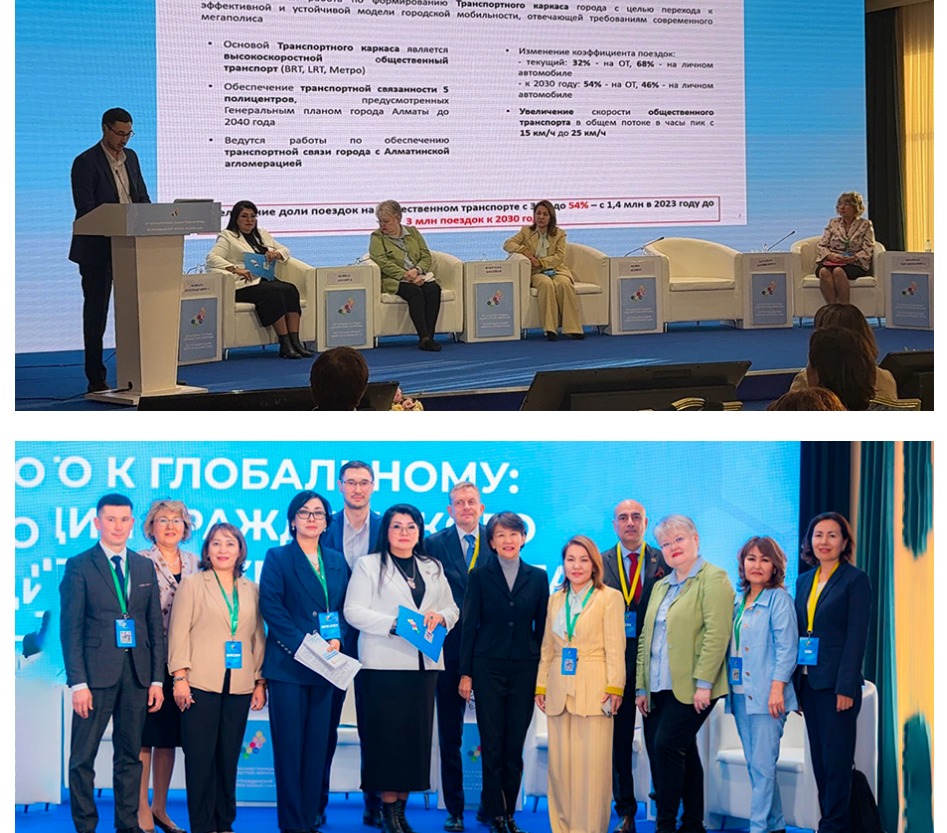
Data, Trust, and Accountability: CIOM’s Contribution to SDG “Localization” at Kazakhstan’s 12th Civil Forum
Within the framework of Kazakhstan’s 12th Civil Forum (Astana, 15 October 2025), the thematic session “From Local to Global: How Civil Society Organizations Advance the SDGs in Kazakhstan” was not merely another discussion of the sustainable development agenda. It was a substantive conversation about how the SDGs are translated into governance practice specifically at the level of cities, districts, and local communities. In this context, a key contribution was made by Gulzhan Toktamysovna Alimbekova, Director of the Public Opinion Research Center (CIOM), during the segment focused on the Voluntary National Review (VNR), public assessment instruments, and civil society engagement within the global SDG monitoring architecture through the UN High-Level Political Forum (HLPF).
1. Why Research Centers Are Becoming the “Infrastructure” of SDG Implementation
The SDGs are not only a list of targets; above all, they represent a system of governance accountability. The state assumes commitments, society expects measurable improvements, and international partners assess progress against standards of comparability and transparency. This triad reveals a gap that cannot be closed by administrative reporting alone: it requires evidence on people’s real social experience access to services, barriers, the quality of interaction with institutions, perceived fairness, and levels of trust.
This is where the role of research centers becomes decisive. In this framework, CIOM is neither a “commentator” nor an external observer; it is part of the practical infrastructure. It helps translate public expectations and everyday social challenges into indicators, trends, and evidence. This shifts the very approach to sustainable development: the SDGs cease to be a “table of goals” and become a feedback system connecting the state and society.
2. VNR as an Indicator of System Maturity: CIOM’s Perspective
During the session, it was emphasized that Kazakhstan presented its latest Voluntary National Review at the UN High-Level Political Forum in New York. Yet the meaning of the VNR today extends beyond an international presentation. It serves as a test of the maturity of the national SDG implementation system across three criteria:
1. Credibility (the extent to which the review relies on verifiable data rather than declarations),
2. Inclusiveness (the degree to which civil society and independent expertise are integrated into preparation),
3. Interpretation (whether the review explains the drivers of progress and “bottlenecks,” rather than merely reporting indicators).
Gulzhan Toktamysovna’s intervention was important precisely as a professional clarification: in preparing and discussing a VNR, quality is not exhausted by the format of a report. It depends on whether the country has sustainable mechanisms that “stitch together” statistics, governance decisions, and the voice of society. Such “stitching” is impossible without regular measurement of public opinion and social effects at the local level.
3. People’s ScoreCard: Public Monitoring as a Governance Resource
A distinct emphasis in the intervention was placed on People’s ScoreCard (PSC) as a tool for public assessment of SDG progress. It is essential to understand that PSC is not a “parallel report” designed for criticism, nor an alternative statistics system. In a well-designed model, PSC performs another function: it complements government data by measuring what often remains outside administrative reporting.
In essence, PSC captures three dimensions without which the SDGs cannot function as policy:
- Access barriers (what prevents people from using services and opportunities),
- Quality and fairness (how the distribution of resources and decisions is perceived),
- Impact on everyday life (what actually changes in the daily lives of households and communities).
The strength of the approach articulated by CIOM lies in its pragmatism: public monitoring must be not symbolic but operational designed so that its results can feed into planning, program adjustments, and budget prioritization at the local level.
4. “From Local to Global”: How Data Becomes Representation
The key idea of the whole session is to connect local experience with global reporting, the connection does not occur automatically. There is a bridge between the "local problem" and the "international agenda," and this bridge is built from data, methodology, and legitimate participation procedures.
The participation of civil society together with researchers in HLPF and in the preparation of national reviews becomes meaningful only when it is based on:
- Representativeness (it is clear whose voices are represented and on the basis of what),
- Comparability (metrics and conclusions can be compared over time and between territories),
- Transparency (it is clear how the data is collected and how the results are interpreted),
- Transformation into solutions (there is a feedback mechanism, from discussion to implementation).
CIOM attaches great importance to these approaches and maintains the discipline of quality, separates individual opinions from trends, emotions from measurable patterns, slogans from evidence-based argumentation.
5. What This Contribution Means in Practice for Kazakhstan
If we translate the expert points into the language of governance, CIOM’s contribution to the SDG discussion in Kazakhstan can be described as advancing three principles:
1. Localization begins with diagnosis, not reporting. Territories differ not only economically, but also in access to services, cultural norms, infrastructure, and social capital. Standardized solutions yield limited impact if they are not grounded in a data-driven “portrait” of a territory.
2. Accountability is a procedure, not an event. A one-off forum or a single report does not create trust. Trust is produced through a repeatable cycle: measure → discuss → decide → verify impact → adjust.
3. The voice of civil society becomes stronger when supported by evidence. Civil society engagement in national and international dialogue is more effective when expressed through data, monitoring, and clearly formulated proposals not only through positions and statements.
Conclusions
The substantive value of CIOM Director Gulzhan Toktamysovna Alimbekova’s participation in the thematic session was that the conversation about the SDGs moved from general support for “sustainable development” toward the domain of governance implementation: what we measure, how we include society, and how local data becomes the basis for decisions and for national/global reporting.
For Kazakhstan, this is particularly important under conditions of increasing social complexity, territorial disparities, and heightened public sensitivity to fairness and institutional quality. Sustainable development inevitably rests on trust. And, as the session’s discussion made clear, trust is built where there is evidence, transparency, and a systematic feedback loop between the state and society where data becomes not a “supplement to a report,” but an instrument of shared responsibility.