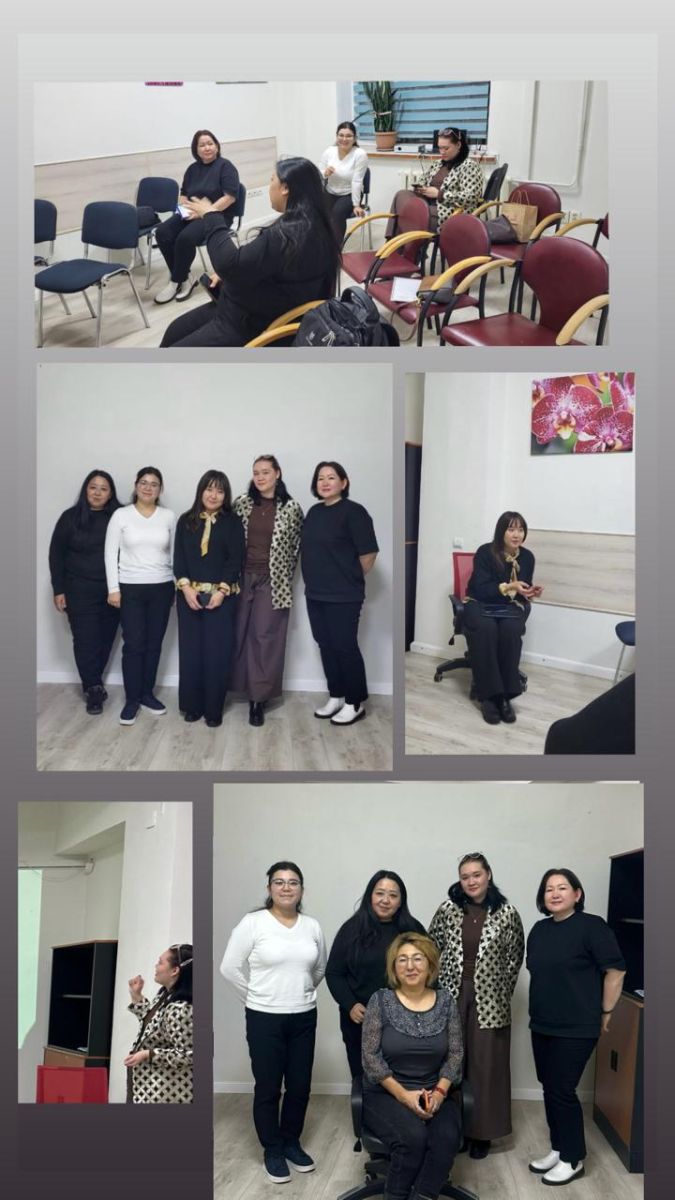
Meet-up at CIOM: how to be a researcher in contemporary Kazakhstan
On 11 December, the office of the Public Opinion Research Center (CIOM) hosted the second meet-up in a series of meetings for doctoral students and early-career researchers, dedicated to the theme “The culture of being a researcher: management, learning from mistakes, and civic responsibility.” The creation of this series was made possible thanks to the strategic support of CIOM’s Director, Gulzhan Toktamysovna Alimbekova, Candidate of Sociological Sciences, who consistently advances the idea of developing a national research school and building sustainable platforms for professional dialogue. The format concept and program content of the meet-ups were developed by CIOM project manager and PhD candidate at Al-Farabi Kazakh National University (KazNU), Ainur Aibynovna Bakytzhanova. This combination of institutional leadership and bottom-up initiative made it possible to launch a regular series of meetings focused on the real needs of young scholars.
The second meet-up brought together doctoral and master’s students from Al-Farabi Kazakh National University, Narxoz University, researchers from Brif Research Group, as well as representatives of other academic and applied organizations in Almaty. Among the participants were both those who are only beginning their research careers and those who already combine their studies with teaching and project work. As a result, the discussion was not abstract, but grounded in lived experience from first steps in fieldwork to the complex management of multiple academic and applied tasks.
The agenda of the meet-up focused on three key dimensions of research culture: managing research work, attitudes toward mistakes, and the civic responsibility of the scholar. PhD Aruzhan Aidarkhanovna Saymashayeva, lecturer in the Department of Sociology and Social Work and project assistant at the Joint Center for Sustainable Development in Central Asia (Hong Kong Polytechnic University and KazNU), in her presentation “Management in doctoral studies: managing workflow and self-organization,” presented the PhD trajectory as a form of complex management. She showed that today’s doctoral student manages not only the dissertation text, but also time, emotional resources, institutional expectations, and project commitments. At the center of the discussion were designing a realistic research plan, balancing fieldwork, data analysis, publication activity and personal life, as well as strategies for preventing professional burnout.
Sabina Berdizhanqyzy Abudanish, a fourth-year student at Narxoz University and researcher in the qualitative research department of Brif Research Group, in her talk “The culture of mistakes: how not to be ashamed, but to learn” treated error as a normal and productive element of the research process. Using concrete examples, unsuccessful interview guides, failed recruitment, difficulties in interpreting ambiguous data she showed how open discussion of missteps helps refine methodology, strengthen trust within research teams, and shape a more mature professional identity.
Ainur Aibynovna Bakytzhanova, CIOM project manager and PhD candidate at KazNU, in her presentation “Independent Kazakhstan: historical memory, the spirit of unity, and civic responsibility” linked empirical research work with a broader political and social context. The talk addressed how research results in the fields of social policy, inequality, education and employment relate to issues of historical memory, social cohesion, and everyday civic practices. A separate focus of the discussion was the extent to which the researcher is responsible for the interpretive accents they choose in working with data and for how their conclusions may influence the public agenda.
At the beginning of the meeting, a brief interactive survey of participants was conducted: what is currently the most difficult aspect of their research work, what they would most like to learn, which topics should be addressed at future meet-ups, and whom they would recommend as future speakers. The responses showed that the key needs are linked to time and workload management, practical skills in writing articles and grant applications, finding partners for fieldwork, as well as emotional resilience and overcoming the sense of isolation in academia.
The discussion block centered on the question: “To whom does a researcher in Kazakhstan today bear primary responsibility, to science, to society, or to their own career?” The debate showed that, for young scholars, these three dimensions cannot be reduced to one another. Scientific integrity, sensitivity to the social consequences of research, and the need to plan one’s career realistically are perceived as elements of a single model of responsibility. Participants stressed that a researcher cannot fully retreat into “pure theory,” ignoring the social effects of their work, but also should not turn science into a purely career-oriented resource.
For CIOM, this series of meet-ups is part of a broader mission to develop the research ecosystem in Kazakhstan. The Centre provides a venue, organizational and expert support, creating a space where not only research results but also research processes can be discussed: project management, work with data, ethical dilemmas, and the linguistic and civic stance of the researcher. An important principle is the horizontality of communication: doctoral students, master’s students, undergraduates and practicing researchers talk to each other not in a format of formal reporting, but in a mode of professional exchange and mutual learning.
In the longer term, this series of meetings may evolve into a stable community of doctoral and early-career researchers, where different thematic and methodological lines intersect, joint projects emerge, and new research coalitions are formed. For Kazakhstani scholarship, this means not only strengthening human capital, but also developing a culture of responsible, reflexive research aimed at understanding complex social processes and reducing forms of inequality. The CIOM initiative to support such meet-ups demonstrates that institutional infrastructure and individual initiative of researchers can complement each other, shaping a new norm of open and professional scientific dialogue.