School Nutrition Research in Kazakhstan: Experience of the “Food for the Future” Project within Research Sprint
Introduction
On June 3, 2026, the final of the first KAPIOR Research Sprint research project competition was held, bringing together students, researchers, businesses, and the expert community to address real-world social and economic challenges.
First and foremost, we would like to express our gratitude to the companies and partners that supported the competition and proposed project tasks of practical relevance to business and society. The particular value of Research Sprint lies in the fact that research findings do not remain merely academic exercises, but can serve as a basis for real-world decision-making.
For Public Opinion Research Center (CIOM), participation in Research Sprint was a continuation of its work to promote research culture and support young professionals. Gulzhan Toktamysovna Alimbekova, Director of Public Opinion Research Center and a KAPIOR member, served as the project mentor on behalf of CIOM. Together with Olga Karaeva, she supported the student team from Kazakhstan-German University (DKU) throughout all stages of the research project.
As part of the project, the student team conducted a comprehensive applied study of school nutrition from the perspective of parents. The research focused on parental satisfaction with the quality and safety of school meals, levels of trust in the existing state monitoring and control system, and parents’ perceptions of the impact of school nutrition on children’s health and everyday well-being. Based on the empirical data collected, the team identified key areas of concern and developed practical recommendations aimed at further improving approaches to the organization and assessment of school nutrition. The findings were presented to the project client, Almira Orlova, founder of the ASTAU project and the healthy food brand Ragout Kazakhstan, for further practical application and development of relevant initiatives.
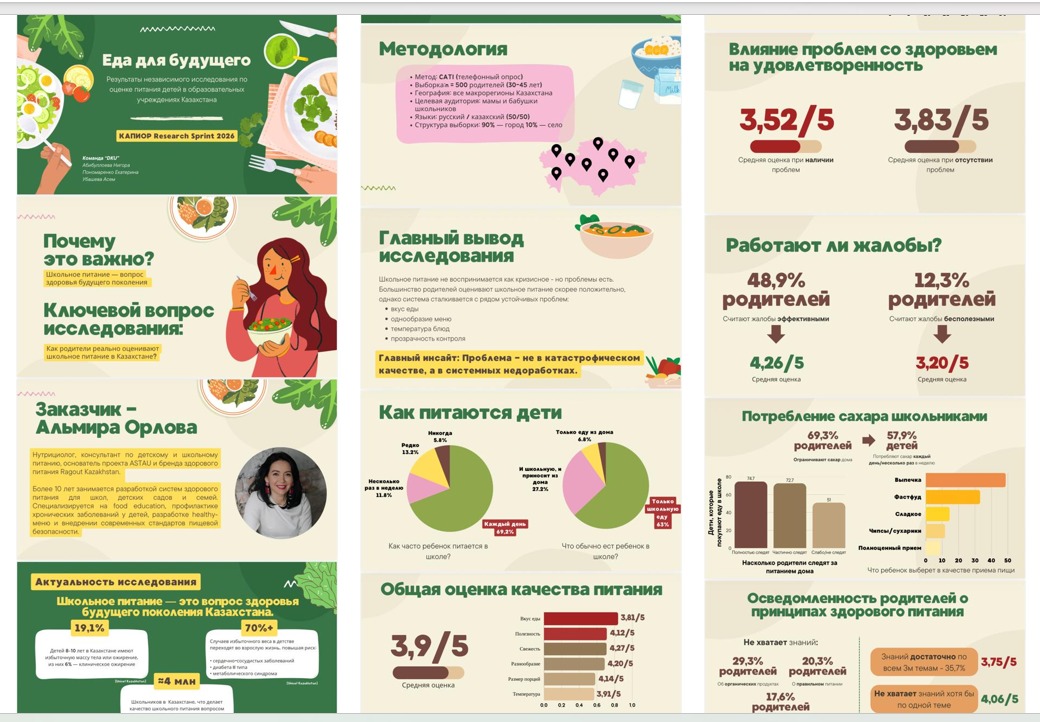
CIOM supported the Kazakhstan-German University (DKU) team, which presented the research project “Food for the Future: An Independent Assessment of Children’s Nutrition in Educational Institutions in Kazakhstan.”
Following the competition, our team took second place.
The team consisted of third-year students from the Marketing educational program: Nigora Abibulloyeva, Ekaterina Ponomarenko, and Asem Ubasheva. The academic supervisor of the project was K. B. Kashkimbayeva, Senior Lecturer at the Faculty of Economics and Entrepreneurship.
The project focused on an independent assessment of school nutrition in Kazakhstan through parents’ perceptions. The study included 500 parents from different regions of the country and was conducted using computer-assisted telephone interviewing (CATI).
The team was tasked with conducting an independent applied study capable of providing evidence-based answers to questions concerning the quality, safety, and accessibility of school nutrition.
1. Research Methodology: From a Social Problem to a Research Model
The topic of school nutrition was not chosen by chance. In recent years, issues related to children’s health, food quality, the growing prevalence of diet-related diseases, and the development of dietary habits have increasingly become subjects of public debate and expert attention.
The study was based on the principle of independently assessing the school nutrition system through the perceptions of parents as direct participants in the educational process. The research object was the school nutrition system in public and private schools in Kazakhstan, while the research subject included food quality, food safety, accessibility of school meals, and their perceived impact on children’s health.
To collect the data, a quantitative telephone survey of 500 parents from different regions of Kazakhstan was conducted. The sample included both urban and rural residents, as well as parents of children attending public and private schools.
The methodological value of the project lay in its attempt to examine school nutrition not only as a service provided by educational institutions, but also as an element of the broader public health system. Accordingly, the study included questions concerning satisfaction with food quality, incidents of violations and food poisoning, parental awareness, the role of the family in shaping dietary habits, and perceptions of existing control mechanisms.
Particular attention was paid to the issue of trust. For any social system, objective indicators are important, but so is how citizens perceive that system. Parents need to understand who is responsible for monitoring food quality, how decisions are made, and how they can influence the situation when problems arise.
2. Key Research Findings: Between Satisfaction and the Demand for Change
The findings revealed a relatively complex picture.
On the one hand, the majority of parents evaluated school nutrition positively. Almost 70% of respondents expressed a high level of satisfaction. The highest ratings were given to the freshness of food products, menu variety, nutritional value, and portion size.
The study also showed that school nutrition is an integral part of the daily lives of most children. More than 72% of schoolchildren eat at school every day, while almost two-thirds primarily consume food provided at school.
However, behind this overall satisfaction lie several important issues.
First, a significant proportion of parents have insufficient information about the content of school meals. More than 70% of respondents do not know the calorie, protein, fat, and carbohydrate indicators (KBJU) of the school diet, while almost half either do not review the menu or do not know where it can be accessed. This indicates insufficient transparency of the school nutrition system for parents.
Second, the study identified a consistent demand for improvements in food quality. Among the most important areas for improvement, parents highlighted the quality of food products, increasing the amount of vegetables and fruit, strengthening sanitary controls, and expanding menu variety.
Third, children’s food preferences deserve particular attention. According to parents, when given freedom of choice, children are more likely to choose baked goods, fast food, sweets, and snacks rather than a balanced meal. These findings point to a broader issue concerning the development of a healthy food culture that extends well beyond the school cafeteria.
Finally, the study identified important concerns regarding trust in the monitoring system. More than one-quarter of parents do not know who is responsible for monitoring the quality of school meals. One in three is uncertain whether public or parental oversight exists. These findings demonstrate that monitoring is not only an organizational issue, but also a communication challenge.
3. Why School Nutrition Requires Further Research
The study made it clear that school nutrition is not an isolated area, but part of a broader system of relationships between families, schools, and the state.
One of the most interesting findings was the absence of a direct relationship between parents’ overall satisfaction and their level of awareness of the school nutrition system. While most parents evaluate school meals positively, a substantial proportion do not know the composition of the menu, the principles used to design the diet, the KBJU indicators, or the mechanisms for monitoring food quality.
Another important conclusion concerns the broader meaning of nutrition for parents. The issue extends far beyond the organization of school lunches. In public perceptions, healthy and high-quality nutrition is associated with safety, health, disease prevention, and the development of children’s long-term habits. This is why the most prominent demands concern not the cost or size of portions, but rather food quality, menu diversity, the availability of vegetables and fruit, and the monitoring of sanitary conditions.
The study also showed that modern families perceive schools as participants in the formation of children’s food culture. Parents expect the education system not only to provide children with food, but also to contribute to the development of healthy behavioral patterns. In this sense, the social function of school nutrition is expanding from a service provision function toward a broader public health instrument.
From a research perspective, this makes it possible to view the school nutrition system as one of the indicators of the quality of public policy. Parents’ attitudes toward school meals reveal broader issues of institutional trust, transparency of administrative decisions, access to information, and the effectiveness of public oversight.
Conclusion
The “Food for the Future” project was not only a study of school nutrition, but also practical evidence that researcher development does not begin solely in the classroom or with the study of individual research methods. It begins when there is a real problem, a real client, real data, and responsibility for the results produced.
One of the most important outcomes of Research Sprint was the creation of a space in which universities, research companies, and businesses acted not as separate participants, but as elements of a shared research ecosystem. This type of interaction is likely to play an important role in shaping the development of applied sociology and marketing research in the coming years.
Today, the research industry faces not so much a shortage of data as a shortage of professionals capable of transforming data into knowledge and knowledge into decisions. Under these conditions, formats that enable young researchers to complete the full project cycle and understand the practical significance of their profession become particularly valuable.
In our view, the future of the research market will be shaped by stronger project-based learning, the development of mentorship, and expanded partnerships between the academic community and the professional research industry. The next generation of competitions will increasingly assess not the volume of theoretical knowledge, but the ability to address real social and market challenges.
For KAPIOR, Research Sprint was not simply a student competition, but a pilot of a new model for developing research talent. For research companies, it represented an opportunity to invest in the professional future of the industry. For universities, it provided a mechanism for integrating education and practice. For students, it offered their first experience of working within professional standards.
We, the CIOM team, believe that initiatives of this kind are precisely what can help shape a new generation of researchers in Kazakhstan professionals who are capable not only of collecting data, but also of understanding society, identifying problems, formulating meaningful questions, and working with evidence. Ultimately, the development of research culture is one of the conditions for improving the quality of decision-making in both business and social policy.
We express our gratitude to KAPIOR, the competition partners, the academic supervisor of the project, the student team, and all Research Sprint participants for their collaborative work, which demonstrated that research can be more than an academic exercise it can be a meaningful instrument for understanding and transforming social reality.